Press "Enter" to skip to content

Month: October 2016

October 15 is Pregnancy and Infant Loss Day

Original link

Ontario declared October 15 as Pregnancy and Infant Loss Day very late in 2015, so tomorrow will be the first time this day of remembrance has taken place.

Losing a pregnancy or an infant is a peculiarly difficult form of loss — invisible as all losses are invisible to those outside them, but also with the additional loss of a lifetime of possibility and the very physical sequelae unavoidable at the end of a pregnancy. It’s a monstrous, momentous, unexpected loss, but not a form of loss that we talk about often, although it’s far from uncommon. Perhaps this day of remembrance will help bring the conversation about this form of loss further into the vernacular.

I recently read An Exact Replica of a Figment of My Imagination, Elizabeth McCracken‘s memoir of her stillborn son. She writes about her grief with perceptiveness and clarity and even humour:

“Perhaps it goes without saying that I believe in the geographic cure. Of course you can’t out-travel sadness. You will find it has smuggled itself along in your suitcase. It coats the camera lens, it flavors the local cuisine. In that different sunlight, it stands out, awkward, yours, honking in the brash vowels of your native tongue in otherwise quiet restaurants. You may even feel proud of its stubbornness as it follows you up the bell towers and monuments, as it pants in your ear while you take in the view. I travel not to get away from my troubles but to see how they look in front of famous buildings or on deserted beaches. I take them for walks. Sometimes I get them drunk. Back at home we generally understand each other better.”

It must have been a cathartic book to write, as it certainly is to read.

If you’ve experienced such a loss — as some of us here at Health Nexus have — our hearts are with you, on October 15 and every day.

In Ontario, the Pregnancy and Infant Loss Network (PAIL) offers support groups for bereaved families in many locations, as well as butterfly releases in two cities. See their website for details.

Comments closed
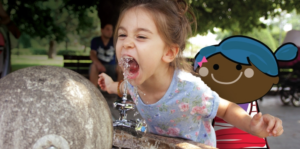
Healthy Kids Community Challenge: “Water Does Wonders”

Original link

As a member of the Healthy Kids Resource Centre, HC Link is proud to support the Healthy Kids Community Challenge program. This program promotes children’s health by focusing on a healthy start in life, healthy food, and healthy active communities. After nearly a year on the first theme of the program “Run. Jump. Play. Every Day.”, in July the 45 participating communities launched into the second theme, “Water Does Wonders”.

Water Does Wonders
Source: http://healthykidsniagara.ca/water-does-wonders

The principal message of this theme is to encourage kids to drink water instead of sugar-sweetened beverages when they are thirsty. Sugar-sweetened beverages are completely unnecessary as part of a healthy diet. The Heart and Stroke Foundation says:

“Consuming too much sugar is associated with heart disease, stroke, obesity, diabetes, high blood cholesterol, cancer and cavities.”

How can we encourage children (and their families) to drink more water, and to drink water instead of sugary drinks? The 45 participating communities have lots of ideas.

A popular idea is distributing reusable water bottles to kids. A number of communities encouraged families to photograph themselves with their reusable water bottles while engaging in various physical activities, and to share their photos on social media.

When one has a reusable water bottle, it’s important to be able to refill it. To fill this need, various communities are installing refill stations.

As another idea to illustrate “Water Does Wonders” for health, in the summer various communities sponsored free swims – water in enormous quantity!

For other participating communities, clean, drinkable, safe water is not easily available. In these communities, participants are working to improve access to clean water as a necessary co-requisite to encouraging children to drink more water.

Follow the participating communities on Twitter in English #HealthyKidsON and #IChooseTapWater and in French #enfantsensanteON.

Comments closed

Social Innovation: It’s about Systems Change

Original link

On September 26 I went to a Social Impact Generation session at the Centre for Social Innovation (CSI) on “The culture, passion and how for social innovation”.

I couldn’t immediately remember why I had thought it so important to attend, but it became quickly apparent: several of the guests were from Australia and would talk about TACSI, the innovation lab there, and another guest had been involved in the Kafka Brigade which I’ve always enjoyed.

We hear the word “innovation” a lot in health promotion, often applied somewhat haphazardly, but I was pleased to hear that TACSI’s innovation focus was on system change. They believe all people should have the opportunity to have a good life and to have a say in what that looks like. Health promoters will recognize a close echo of the WHO definition of health promotion in that statement, altough TACSI doesn’t call themselves health promoters.

They see system change developing through four channels:

  1. Understand the problems and opportunities people experience and built empathy for people and systems. Unpack the assumptions.
  2. Consider how you design for that truth. What approaches, methods and tools might you use?
  3. Take a capability-building, mutual-learning approach.
  4. When the first three aren’t enough, accept that you’re working on a profound systemic challenge. This is the most intangible level, and you’ll need to experiment to shift systems so people can live good lives.

Several points struck me as interesting for health promoters to consider:

  • The use of the word “capability” where we would typically use the word “capacity”. I think we may wish to consider using “capability” more often — it’s more easily understood and sounds more active.
  • One presenter emphasized that while we are often good at collaborating with people with like minds, to really change systems we need to learn “conflictual collaboration” — that is, to collaborate across difference and disagreement, and to be more comfortable not liking each other.
  • All presenters agreed that lots of failures are part of the process in systems change. Innovation labs can be useful, not only as places to encourage ideas and experiments but also as places where people can learn from the failures of others instead of repeating them.
  • They noted that idea generation is not an end in itself and doesn’t change the world. You have to act, even knowing that most of your experiments won’t succeed with any rigour. So connect and act!

A video of the evening is now posted.

Comments closed