Press "Enter" to skip to content

Category: OHPE

US Election Editorial – OHPE Bulletin 961

Original link

Fellow health promoters, it was almost exactly a month ago that Donald Trump became US President elect. We feel it is important to acknowledge that this is far from good news. His lack of concern or regard for the environment, for diversity among US residents, for science, and for truth may have devastating results for health — mental, physical, emotional, and spiritual — in the US and beyond.

What can we do as Canadian health promoters?

We can keep doing the sometimes invisible but always important, essential work of health promotion; this is the work that creates the kind of society we hope will help prevent a similarly dangerous person from being elected here. Let’s keep working on the social determinants of health and continue to work towards a Canada where all residents lead good lives free of fear and without the kind of social isolationism Trump espouses. Let’s work on system change to prevent discrimination and call it out when it does happen. Let’s keep working to reduce inequality and promote opportunity so that people can be their best selves. Let’s welcome our newcomers and help people see the strength in our terrific diversity.

In short: let’s keep doing what we always do as health promoters.

Here’s to all of you and all of your sometimes invisible but always essential work.

— the OHPE team

Comments closed

Letter from the Editors: October 2015 Federal Election Resources, OHPE Bulletin 906

Original link


Contents

I Introduction
II Official Election Site
III The Parties
IV News and Information Sources
V Polling Sites
VI  Issues and Advocacy
VII Events
VIII Hashtags
I Introduction

Here is our usual collection of election-related resources for health promoters. This time, we’re running the feature a month before the October 19 federal election — we’ll add new items as they arise.

II Official Election Site

Elections Canada
http://www.elections.ca/

III The Parties

The full list of registered parties is on the Elections Canada website:
http://www.elections.ca/content.aspx?section=pol&dir=par&document=index&…

Here are direct links to the websites of parties most often mentioned in the media:

Bloc Québécois
http://www.blocquebecois.org/

Conservative
http://www.conservative.ca/

Green
http://www.greenparty.ca/

Liberal
http://www.liberal.ca/

New Democratic
http://www.ndp.ca/

IV News and Information Sources

Canoe.ca
http://cnews.canoe.com/CNEWS/Election2015/

CBC
http://www.cbc.ca/news/politics

Chronicle Journal (Northwest Ontario)
http://www.chroniclejournal.com/news/national/

CTV
http://www.ctvnews.ca/politics/election

Globe and Mail
http://www.theglobeandmail.com/news/politics/federal-election-2015/

Kitchener-Waterloo Record
http://www.therecord.com/waterlooregion-news/canada

Maclean’s
http://www.macleans.ca/tag/federal-election-issues-2015/

National Post
http://news.nationalpost.com/tag/federal-election-2015

Northern Life
http://www.northernlife.ca/news/elections/federal/2015/

Ottawa Citizen
http://ottawacitizen.com/category/news/politics

Toronto Star
http://www.thestar.com/news/federal-election.html

V Polling Sites

Ekos Election
http://www.ekospolitics.com/

Nanos Research
http://www.nanosresearch.com/main.asp

ThreeHundredEight.com
http://www.threehundredeight.com/

VI  Issues and Advocacy

Broadbent Institute
http://www.broadbentinstitute.ca/democratic_renewal

Call for Housing
http://www.callforhousing.com/

Campaign for National Drug Coverage
http://campaign4nationaldrugcoverage.ca/

Canadian Association of Community Health Centres
http://www.cachc.ca/federalelection

Canadian Centre for Policy Alternatives
http://behindthenumbers.ca/category/federal-election/

Canadian Diabetes Association
http://www.diabetes.ca/how-you-can-help/advocate/election-central

Canadian Federation of Students
http://cfs-fcee.ca/take-action/let-people-vote/

Canadian Medical Association – Promise Tracker
http://www.demandaplan.ca/

Canadian Nurses Association
http://www.election.cna-aiic.ca/en/cnas-platform

Canadian Public Health Association
http://www.cpha.ca/en/election2015.aspx

Canada Revenue Agency – Advisory on partisan political activities
http://www.cra-arc.gc.ca/chrts-gvng/chrts/cmmnctn/pltcl-ctvts/dvsry-eng….

CBC Video: Comparing the major parties on child care promises
http://www.cbc.ca/news/politics/canada-election-2015-comparing-the-major…

Centre for Research on Inner City Health Research Flash (often does special issues for elections)
http://www.stmichaelshospital.com/crich/research-flash.php

Charity Village: Outcomes for Canada’s charitable sector
https://charityvillage.com/Content.aspx?topic=Elections_2015_Outcomes_fo…

Council of Canadians
http://canadians.org/election/

David Suzuku Foundation – Blue Dot – How to get involved in your local all-candidates debate
http://bluedot.ca/stories/how-to-get-involved-in-your-local-all-candidat…

Dental Hygiene Canada – Access to Care for All Canadians
http://www.dentalhygienecanada.ca/DHCanada/Your%20Oral%20Health/Communit…
Sample tweets of key messages: https://www.cdha.ca/pdfs/voice4OralHealth-final2.pdf

Dietitians of Canada
http://www.dietitians.ca/Dietitians-Views/Federal-Election.aspx

Equal Voice
http://www.equalvoice.ca/index.cfm

Fair Vote Canada
http://www.fairvotecanada.org/

Food Secure Canada: Eat Think Vote
http://foodsecurecanada.org/EatThinkVote

Generation Squeeze (younger Canadians)
http://www.gensqueeze.ca/join?splash=1

Good for Canada: A platform to end income inequality in Canada
http://goodforcanada.ca/

Heart & Stroke Foundation: Healthy Candidates Challenge
http://healthycandidates.ca/

Imagine Canada Election Hub
http://www.imaginecanada.ca/advocacy/election-2015

LatinXVote
https://www.facebook.com/LatinXVote

Make Poverty History
http://www.makepovertyhistory.ca

Maytree: Getting Poverty on the Election Agenda
http://maytree.com/blog/2015/08/getting-poverty-on-the-election-agenda/

Ontario Coalition for Better Child Care
http://www.childcareontario.org/vote_child_care_2015

Rabble.ca Election blog
http://rabble.ca/issues/elections

Research Canada: Your Candidates, Your Health
http://yourcandidatesyourhealth.ca/

Samara’s Democracy 360
http://www.samaracanada.com/research/samara-democracy-360

Social Planning Council of Toronto Fact Sheets
http://www.socialplanningtoronto.org/news/canada-votes-2015-federal-elec…

Social Planning Network of Ontario
http://www.spno.ca/canada-votes-2015

Vote Child Care
http://pledge.votechildcare.ca/

YWCA Toronto blog (many election-related posts)
http://blog.ywcatoronto.org/

VII Events

GreenPac Forum on translating Canadians’ environmental concerns into political action
September 25 8am EDT
http://sustainabilitynetwork.ca/greenpac-forum-with-aaron-freeman/

VIII Hashtags

#elxn42
#votehealthy


The OHPE Editorial and Management Team encourages all eligible readers to cast their ballots!

Comments closed

Is data a health promotion issue?

Original link

Contents

I Introduction: No more long-form census
II Open data
III Big data
IV Health promoters and data
V Resources

I Introduction: No more long-form census

In 2010, the Canadian government cancelled the long form of the census, which previously was sent to 20% of Canadian households and which – critically – was mandatory. If you received the long form, you heaved a deep sigh, brewed yourself a fresh pot of tea and settled yourself at the kitchen table with more than one sharp pencil. You had no choice: a determined, persuasive person would eventually arrive at your door to follow up should you fail to complete it. Aside from a few dedicated pranksters such as a friend of mine who used to ensure she was deep in the woods on the day upon which census questions focused so she could honestly answer “Electricity: no. Indoor bathrooms: zero” and the like, the long-form census data represented Canadians’ household situations fairly well.

On the other hand, the National Household Survey, intended to replace the long form, is voluntary. It is sent to 30% of Canadian households but, unsurprisingly, given the rather nosy nature of many of the questions and the sheer size of the survey, many fewer households choose to complete it.

We simply don’t have the data we once did.

Which means, of course, that surfacing differences and potential issues across Canada and making evidence-based programs, policies, and decisions has become more difficult – and sometimes impossible. Is data a health promotion issue? Yes, it is.

With such low response rates, are the data we do have reliable? The previous head of Statistics Canada thinks not (http://www.huffingtonpost.ca/2015/05/08/canada-national-household_n_7243…). It’s possible that the data we have misrepresent the population. Thus, it’s also possible that if we make decisions based on these data, our decisions may be incorrect even if our intentions are good.

Furthermore, neither the census nor the National Household Survey asks health-related questions. Without reliable data on some of the determinants of health, such as income, developing evidence-based policy or even raising issues of inequality becomes yet more difficult. For example, back in May the Mowat Centre released its map of the Hardest Places to Live in Canada and highlighted the difficulties it faced in obtaining adequate data for its report (http://mowatcentre.ca/where-are-the-hardest-places-to-live-in-canada/). Health is covered only in the much smaller Canadian Community Health Survey.

Unable to rely on federal data, provinces, regions, municipalities, and organizations are forced to collect their own data. While this ensures that they collect the exact data they need, it’s problematic. It’s more expensive than the census was and it produces data that may or may not be comparable across provinces, regions, and municipalities. Perhaps they all collect data on the same things and organize them in the same way, but odds are they don’t. Making comparisons and spotting trends across regions thus becomes impossible.

II Open data

On the other hand, a number of data-coordination efforts at various levels have arisen, generally falling under the rubric of Open Data. Perhaps due to resource limitations and fiscal pressures, governments, coalitions, and individual organizations are becoming more willing to release the data they do have for public use. See the Resources section for a few examples.

“Open data” is the idea that if you produce data which are reasonable to share, you ought to make them available to others. A key point is that data you release need to be usable by others: they need to be able to manipulate the data easily on their own, either to reproduce analyses you have done or to do further analyses of their own. Here is a two-minute music video which excellently describes open data principles:

A brief diversion on the word “free”: it is used in two different senses, gratis (“free as in beer” – something that is without charge to the user) and libre (“free as in speech” – something with which the user can do what s/he likes).  (https://en.wikipedia.org/wiki/Gratis_versus_libre). Ideally, we’d like open data to be both gratis and libre.

What we would not like, however, is for open data to impinge on privacy. Not all data can be or should be open; risks versus benefits must be considered and weighed. Most personal health data naturally falls into the “too risky” category. The lowest level of collation at which data are not personally identifiable needs careful consideration: a level that anonymizes people effectively in a large city due to sheer numbers may leave people easily identifiable in a rural area. Health promoters have a role both in using open data and in being privacy watchdogs. A population lacking adequate informational privacy is not a population empowered to make the best decisions about its health.

Another area of concern for health promoters is the commercialization of data analysis. Private companies may use open data for their own purposes and may not disclose their analytic processes, preferring to sell only their results. Can we trust these commercial analyses? Do they furnish sufficiently valid evidence for decision-making or planning purposes? It is difficult to know.

III Big data

Widespread computerization by businesses and institutions has created massive datasets – generally not open data — which can be mined for trends and other insights. Nearly everything a person does now creates a data trail, which can be sold by the collector and combined with any other data for any purpose.

Big data can be used to inflict modern, more insidious forms of redlining, such as presenting higher prices to those perceived as higher risk. It can imperil privacy. It can be intrusive and/or unwelcome: famously the US chain Target outed a pregnant teenager to her father via the coupons it sent to their house (http://www.nytimes.com/2012/02/19/magazine/shopping-habits.html?pagewant…), and many women who miscarry continue to receive ads for pregnancy- and baby-related items (http://www.theglobeandmail.com/life/relationships/big-data-is-watching-y…).

Of course, big data has its upsides, even for health promoters. Using current tools and analytic techniques, we can use big data to both spot trends in determinants of health and to model potential solutions. For example, we can combine multiple smaller datasets in ways that can be more informative than any would be on their own (http://bds.sagepub.com/content/2/1/2053951715589418). At a practical level, large, combined datasets can help focus everything from literacy programs to disaster planning and recovery efforts on areas of greatest need. Repurposing data which may offer proxy measures on determinants of health could be a valuable avenue of inquiry for health promoters looking to replace or augment census data.

IV Health promoters and data

Health promoters have roles at all levels — as data producers, consumers, and interpreters.

If resources permit, health promoters can be valuable data collectors. As part of our own evaluation and planning efforts we may create data repositories that collect information known nowhere else.

With all data analysis, no matter the data source, often we have many onlookers and few players. Most people don’t wish to analyze data; they wish for someone else to do that difficult work and to present them with results they can use or publicize. Health promoters can do some of those difficult analysis pieces on their own data and/or on open data produced by others.

Health promoters also have a strong role as intermediaries, helping interpret the strengths, gaps, and biases in their own analyses and those of others. Another intermediary role for health promoters is as convenors of or contributors to open data initiatives, helping multiple producers of data work together for collective impact.

In an environment increasingly focused on evidence, health promoters are well placed to consider healthy and unhealthy uses of data and its many uses in enabling people to increase control over, and to improve, their health.

V Resources

Canadian Centre for Policy Alternatives: How the government’s census strategy keeps us in the dark http://behindthenumbers.ca/2015/08/24/how-the-governments-census-strateg…
Munir Sheikh: Bad Info From NHS Will Lead To Bad Planning http://www.huffingtonpost.ca/2015/05/08/canada-national-household_n_7243…

Access denied: Why I can’t report where B.C.’s immigrants come from http://blogs.vancouversun.com/2015/06/25/access-denied-why-i-cant-report…

Mowat Centre: Where Are the Hardest Places to Live in Canada? http://mowatcentre.ca/where-are-the-hardest-places-to-live-in-canada/

That time they tried to do a study but gave up for lack of data http://www.theglobeandmail.com/globe-debate/editorials/that-time-they-tr…

On big data

Small Big Data: Using multiple data-sets to explore unfolding social and economic change http://bds.sagepub.com/content/2/1/2053951715589418

Deconstructing the cloud: Responses to Big Data phenomena from social sciences, humanities and the arts http://bds.sagepub.com/content/2/2/2053951715594635

Redlining for the 21st Century http://www.theatlantic.com/business/archive/2014/03/redlining-for-the-21…

How Companies Learn Your Secrets http://www.nytimes.com/2012/02/19/magazine/shopping-habits.html?pagewant…

Big Data is watching you. Has online spying gone too far? http://www.theglobeandmail.com/life/relationships/big-data-is-watching-y…

On open data

Gratis vs libre https://en.wikipedia.org/wiki/Gratis_versus_libre

Ontario Nonprofit Network Data Strategy http://ontariononprofitnetwork.onefireplace.org/Towards-a-Data-Strategy-…

Canada Social Report: A Compendium of Social Information http://www.canadasocialreport.ca/

Canadian Partnership for Tomorrow Project (data for cancer and chronic disease research) http://www.partnershipfortomorrow.ca/

Open Government Canada http://open.canada.ca/en

Ontario Open Government Initiative http://www.ontario.ca/page/open-government

Toronto Open Data Portal http://www1.toronto.ca/wps/portal/contentonly?vgnextoid=9e56e03bb8d1e310…

The Open Data Song https://www.youtube.com/watch?v=J180r2U2KnY&feature=youtu.be

Datafication and empowerment: How the open data movement re-articulates notions of democracy, participation, and journalism http://bds.sagepub.com/content/2/2/2053951715594634

On privacy

Privacy By Design https://www.privacybydesign.ca/

Why Not Privacy By Default? (75-page PDF) http://scholarship.law.berkeley.edu/btlj/vol29/iss1/3/

We’ll see you, anon: Can big databases be kept both anonymous and useful? http://www.economist.com/news/science-and-technology/21660966-can-big-da…

Comments closed

March 2012 OHPE Subscriber Survey: Who, Where, How? (And responses to your comments!)

Original link

Contents

I Introduction
II Where do OHPE subscribers live and work?
III Who subscribes to OHPE?
IV Topics you want to see
V OHPE on mobile devices
VI Respondent comments
VII Conclusion
VIII Resources

I Introduction

In 1997 the Ontario Prevention Clearinghouse (OPC) and The Health Communication Unit (THCU) began to produce the Ontario Health Promotion E-Bulletin (OHPE) as a venue for information and knowledge exchange between community leaders, researchers, students, intermediaries, and others with an interest in health promotion. Since then, OPC has become Health Nexus and THCU has become part of Public Health Ontario, but OHPE continues. The Bulletin is emailed to subscribers each Friday. Our searchable website at http://www.ohpe.ca holds all content from current and past bulletins.

In March 2012, OHPE ran the latest iteration of our subscriber survey. Every two or three years we survey OHPE newsletter subscribers to assess how we’re doing, spot any developing issues and guide possible improvements.

OHPE had approximately 6,500 subscribers at the time of the survey in March and 1,613 of you were good enough to take an average of 3 minutes 37 seconds to answer the survey. (Thank you!)

In today’s feature we’re pleased to share some of the more interesting results with you.

II Where do OHPE subscribers live and work?

Eighty-five percent of OHPE subscribers are within Ontario, spread among all regions. We were pleased to note that Toronto is not over-represented: about 22 percent of respondents were from Toronto, roughly in line with Toronto’s share of the Ontario population. To serve the needs of this fairly even geographic spread of subscribers OHPE posts events and announcements from across Ontario — please do send us your postings, whether you are in Ottawa, Dryden, Windsor, Sudbury or anywhere else. Seven percent of respondents’ work has a cross-Canada focus. Five percent were from provinces and territories other than Ontario, and the last 3 percent were international.

III Who subscribes to OHPE?

A slight majority (53 percent) of respondents were in the health and health promotion sectors: public health, community health centres, Healthy Communities Partnerships, health care providers, hospitals, and others in health, nutrition or recreation-related fields.

Other major sectors were government, education, and non-profit/non-governmental/volunteer-based organizations.
There were a few (3 percent of respondents or fewer) in the private sector, child/youth groups, First Nations, community coalitions, environmental groups, media and the general public. Trends in the answers from those who said “other” included researchers, military, students, and consultants.

IV Topics you want to see

Trends in answers to the question “Are there topics that you have not seen covered, or would like to see more of, in the OHPE Bulletin? If so, what are they?” included

  • Profiles and practical examples of new or innovative programs, practices and organizations
  • Health equity
  • Social determinants of health
  • Infectious disease / vaccine-preventable diseases / infection control
  • Health promotion in northern / rural / remote Ontario
  • First Nations health / cultural competency
  • Immigrant health
  • More links to resources
  • Knowledge exchange / knowledge translation / research and evaluation. (OHPE is not currently funded to do knowledge translation work. We would be very interested in doing so should funding permit.)
  • Mental health / mental health promotion
  • Social media / social networking
  • Professional development
  • Oral health

We’ll keep this list in mind as we plan feature articles and scan information sources for announcement and event information. If you’d like to write a feature on one of these topics (or on anything else), you can reach our Features Editor at features@ohpe.ca.

Some people asked for more information about topics which are within OHPE’s mandate but which are well covered elsewhere, for example:

V OHPE on mobile devices

A full 25 percent of respondents read (or attempt to read) OHPE on a mobile device such as a Blackberry, iPhone, or iPad. In 2010 this number was only 9 percent.

We asked how user-friendly it felt to read OHPE on a mobile device. Results here were divided: 41 percent of respondents found it not very user friendly or not at all user friendly; 51 percent found it somewhat user friendly and only 8 percent found it  very user friendly.

As was the case in 2010, we do not have funding to provide a separate mobile site or mobile version of OHPE, but we will do what we can to mitigate difficulties for mobile users.

VI Respondent comments

Respondent comments: things people liked

People particularly liked the job postings (which are always popular), the weekly frequency, the current information, the brevity of the email (easy to scan), the diverse topics covered, the event postings, and our Ontario focus.

Respondent comments: things people would change

Many people said “I wouldn’t change a thing” but many others had definite opinions.  Quite a few comments were similar to comments made on previous surveys. See our 2010 survey feature (http://www.ohpe.ca/node/11435) for our comments on the following:

  • More French content
  • Please remove old job posts / events
  • Too Toronto-centric
  • More images
  • Information about books, articles and reading lists, or about organizations
  • Your font offends my eyes
  • More job postings for volunteers, private sector, those with less experience and students
  • Please include salaries on job posts

I’ll repeat one important one here:  our spam filter ate my submission! This does occasionally happen and we’re very sorry. OHPE gets a LOT of spam — sometimes our filters catch things they shouldn’t and we don’t always manage to spot it in time.  If you ever think we’ve somehow missed something you sent to us, email info@ohpe.ca or call 416-408-2249 x2226 / 1-800-397-9567 x2226 and we’ll do our best to track it down.

There were some new trends in comments too.

Not enough time to apply for things

Over the past couple of years we have noticed a definite trend in job posts: in the past they were typically open for about three weeks; now it’s closer to one week. We post jobs and events as soon as we can but sometimes this does lead to extremely short deadlines.

We apologize, and would encourage those posting jobs to consider whether a longer deadline would be possible. It does take time for postings to reach the right people, and for them to put together a solid application.

Need an archive feature for previous bulletins

Done — they’re on the website! Look for the archive links toward the top left-hand column on the website, or for the full archive list see http://www.ohpe.ca/epublish/1.

Cross-Canada content

We’ve had people ask this before but it was particularly strong in this year’s comments. We’d love to post more cross-Canada content, but our funding is Ontario-based at this point.

Make the website prettier

The word “archaic” was used more than once. Ouch! Yes, we agree it needs updating, with an eye to beauty, modernity, and functionality. We’re looking for some funding that would allow us to give the site a facelift.

Several people wanted us to adjust the font size on the website either up or down. You can do this in your browser:

  • Ctrl+ or Ctrl-on Firefox or Chrome
  • Page button then click Text Size in Internet Explorer

More interactive

An interesting thought. People were not specific about what aspects of interactivity they might find useful, but that will be something for us to explore perhaps in our next survey. In the meantime, if you have ideas you’d like us to hear feel free to write info@ohpe.ca.

RSS feed

The site feed is at http://www.ohpe.ca/rss.xml. (Don’t click that link unless you’re using an RSS reader. It’s not meant to be human-readable.)

VII Conclusion

Thanks again to everyone who took time to answer the survey. Your comments help us assess how we’re doing, see technological trends before they bowl us over, and provide you with the most useful newsletter we can produce.

If you have any specific questions about the survey, write info@ohpe.ca.

VIII Resources

View the 2010 OHPE survey results at http://www.ohpe.ca/node/11435.

View past OHPE issues at http://www.ohpe.ca/epublish/1.


Comments closed

Network Mapping for Ontario’s Healthy Communities Partnerships

Original link | resource link

Contents

I What is network mapping?
II Project background and context
III Steps for Healthy Communities Partnerships to create a network map
IV Results: trends and patterns in the Healthy Communities Partnerships’ network maps
V Conclusion

I What is network mapping?

Network mapping is also known as social network analysis.

Social network analysis is the mapping and measuring of relationships and flows between people, groups, organizations, computers or other information/knowledge processing entities. The nodes in the network are the people and groups while the links show relationships or flows between the nodes. Social network analysis provides both a visual and a mathematical analysis of complex human systems.

– Valdis Krebs (http://www.orgnet.com/sna.html)

Specifically, network mapping offers the following:

  • increased understanding of the strengths of existing networks
  • identification of areas within networks that need to be expanded or strengthened
  • methodology to demonstrate growth and change over time.

In short, network mapping and analysis helps groups look at how they are working together now, and how they might work together even more effectively to reach their specified goals.

Network mapping typically does not create an inventory of community assets. It assumes this has already been done. Other processes, such as community mapping, asset mapping, stakeholder analysis are effective tools at that stage.

II Project background and context

Health Nexus (http://www.healthnexus.ca) was contracted by the Ontario Ministry of Health Promotion and Sport  (MHPS, http://www.mhp.gov.on.ca/) in July of 2010 to support network mapping and analysis for the 36 Healthy Communities Partnerships (HCPs, http://www.mhp.gov.on.ca/en/healthy-communities/hcf/partnership.asp).

The purpose of this project was to provide the HCPs with information that would contribute to their community profiles and shape strategies to further strengthen their community connections and linkages, including the February 15, 2011 submission of their comprehensive local profiles, the Community Picture.

Through the use of both electronic survey technology and mapping software, Healthy Communities Partnerships’ network maps provided a baseline ‘snapshot’ of the current levels of connection within each local partnership. Connections, strengths, gaps and opportunities were made visible, helping answer key questions in the network- and community-building process:

  • Are the right connections in place? Are any key connections missing?
  • Is the group as inclusive as it could be? Are all possible sectors, stakeholders, and networks represented?
  • Who plays a leadership role? Who does not, but could?
  • Are there opportunities for enhanced collaboration?
  • Who are the mentors others seek out for advice?
  • How do good ideas spread within this network? Who are the innovators?

(Adapted from: Valdis Krebs and June Holley, Building Smart Communities through Network Weaving, 2002)

Health Nexus has extensive experience in community engagement and network development. Network mapping and analysis provided additional, visually-based tools to assist with this work.

III Steps for Healthy Communities Partnerships to create a network map

  • Consider what people want to learn about their network. Network mapping ideally begins with a discussion of what groups would like to learn about their network, such as the balance between various sectors, geographic regions, ages and genders as well leaders, mentors and innovators in their network. Is the network seeking to discover its hidden leaders to improve its functioning? Is it looking to take advantage of current members’ connections to expand its representation or its work? Is it trying to work on a complex, ongoing or seemingly intractable issue either internally or within the community? Is it focused on how members might collaborate on work in a certain area or on a certain topic? In this project partnerships tended to focus on answering questions key to their community pictures.
  • Develop a contact list of stakeholders. This is a list of people in each partnership who should receive a survey about the network. Choosing who will be surveyed is a key part of the network mapping process. The names of those answering the survey are typically included in the network questions within the survey itself, thus allowing participants to indicate their connections quickly and easily. It is therefore important to take time to construct a participant list that represents the network well and that will be able to help the network answer the questions it has about itself. Network coordinators, facilitators, and organizers are key members of their network and need to remember to include themselves on the participant list for the survey.
  • Contribute ideas for the survey questions. Are there specific sectors, organizations, audiences, age groups, or regions (for example) that the network is particularly interested in exploring? Typically there are about ten multiple-choice demographic questions on the survey and up to four network questions (questions about relationships). In this project, we developed a common set of survey questions that formed the foundation of the network mapping survey instrument. Each partnership had an opportunity to include up to five customized questions specific to their communities, as well as the ability to edit or remove core survey questions to better suit local needs.
  • Send out the electronic survey to community stakeholders. The network map is as strong as the number of people who complete the survey so partnerships needed to send several ‘strategic reminders’ to ensure a good rate of return. Depending on their available time and money, some partnerships offered incentives for survey completion; some made personalized phone calls to remind participants, and some sent email reminders. Of course, no list and no survey are ever perfect, and this project worked under time constraints which provided additional challenges. The average response rate was well over 50%: a very good response especially given that partnerships were in the very early phases of their existence.
  • Look at the maps and analyze/interpret the results. We used the survey data and network analysis software to produce maps and (where necessary) numeric tables. The Partnership’s goals and questions about itself guided the production of the maps: who was included in each map, and which relationships were depicted in it, were controlled and changed as necessary to help the Partnership address its needs. For example, some Partnerships looked at a large map depicting relationships across their entire regions, but also created maps looking at how sub-regions relate in isolation. Some explored the relationships between those working with a particular audience or within a particular sector.

That was the end of the process for this project, but it is important to add:

  • The network develops a strategy to strengthen the network and the work it wishes to accomplish. After this strategy has been in action for some time, network members are often surveyed again and the network is re-mapped, which may lead to another network-improving strategy. This process can be repeated any number of times.

IV Results: trends and patterns in the Healthy Communities Partnerships’ network maps

“Understanding the pre-existing social relationships in a setting is vital in health promotion, not only for encouraging important people to get ‘on side’ with an intervention but also for appreciating how the intervention itself might change social structures.”

Source: Use of social network analysis to map the social relationships of staff and teachers at school. Penelope Hawe and Laura Ghali, Health Education Research 2008 23(1):62-69; doi:10.1093/her/cyl162

Overall health of the Partnerships’ networks

We were very pleased to find that virtually all partnerships had overall network maps displaying the classic pattern of a healthy, strong, well-connected network.

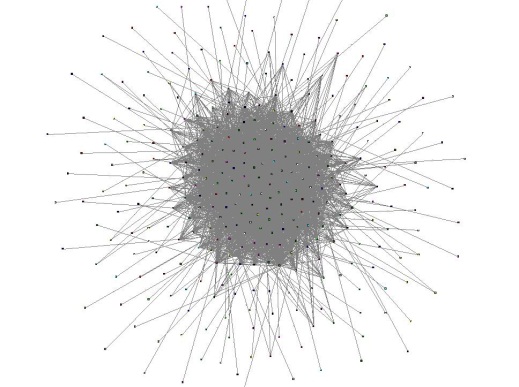
Figure 1 is a typical example of this pattern. There is a core of those who are particularly strongly connected to each other, an inner periphery of those somewhat connected to this network (and probably also connected to other networks as well), and an outer periphery of those connected minimally, whose networks are primarily elsewhere. This periphery forms a field of those who are a potential valuable source of new ideas and information for the partnership network.

Network and periphery

The size of the core, inner periphery and outer periphery varied among the partnerships but all followed this general healthy, resilient pattern. As a baseline, the partnerships are in an excellent position to work in a coordinated way within their communities.

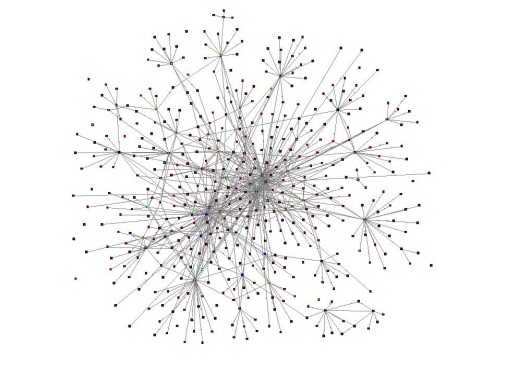
Several partnerships used the network mapping process in a novel way. They used the survey to collect the names of people’s contacts. Instead of listing names, they used an open-ended format which asked for names to be added and relationships. Their network maps show a different, more dendritic pattern of connections (Figure 2), displaying more clearly the networks-of-networks concept than do the maps created with the more standard method. These partnerships were instrumental in developing this method for network mapping in communities where the networks in question are not as easily defined.

This more open structure does not demonstrate a less healthy network; it simply reflects an outward-focused network mapping process designed to collect the names of possibly unfamiliar connections, rather than an inward-focused process directed more towards examining the relationships between defined individuals.

Healthy Communities Fund—top Ministry of Health Promotion and Sport priority area

Some Partnerships were able to use map information to help refine priorities; others are using the maps to guide their work on priorities already defined.

Physical activity and healthy eating

Physical activity and healthy eating were the two priority areas most frequently represented in the network maps.

Mental health promotion

Mental health promotion often took third place on the maps, usually well-integrated with other priorities but sometimes in a more peripheral position.

Injury prevention

Injury prevention was often not well connected to itself in the network maps, possibly because survey participants choosing injury prevention as their top priority came from a diverse range of organizations and fields, including hospitals, police, recreation/sport, or seniors falls prevention. However, several partnerships did show strong injury prevention clusters.

Substance misuse

Substance misuse was often peripheral in the maps, but was frequently represented as a second priority in those partnerships that asked about second priorities.

Tobacco

Tobacco was only sparsely represented—or absent—on most of the network maps.  Extensive work in tobacco cessation over the past 10 years has resulted in networks that have worked successfully with each other, but not necessarily with other priority areas.

V Conclusion

The Network Mapping for Healthy Communities was the first time in Ontario that regional networks have been mapped simultaneously as part of an overall capacity-building strategy to build healthy communities.

The project confirmed that healthy and vibrant networks are alive and well within the Ontario Healthy Communities Partnerships. Building on the strengths of these partnerships, the network maps provide a new, visual tool to identify areas for growth and development and support the creation of appropriate governance structures. Although we are still at an early stage of analysis with the maps, early indications show that network maps will become useful tools for Healthy Communities Partnerships to identify opportunity clusters, plan for community engagement and create ‘networks of networks’ for healthy public policy.

This project has set the stage for work in 2011 – 12 through the Healthy Communities Consortium (http://www.hcconsortium.ca) to continue the analysis of the network maps in the context of the work of the partnerships as well as working with others related to or eligible for grants under the Healthy Communities Fund.  There may also be the possibility of using the maps to identify mentors across the system whose partnerships are particularly strong in certain areas such as francophone integration, indigenous representation, and injury prevention.

Online Resources Related to Feature 713

June Holley’s network weaver website explores the key dynamics in creating healthy communities. June has been weaving economic and community networks for more than 25 years. Her website includes network services, training centre, resources, a blog, and the paper Building Smart Communities through Network Weaving which investigates building sustainable communities through improving their connectivity. http://www.networkweaver.com/index.html.  She also talks about weaving people, ideas and projects on YouTube at http://www.youtube.com/watch?v=8nXbi3xQsSs.

The Network Thinkers is focussed on “exploding” old concepts and thinking about economies, organizations, communities and groups. http://www.thenetworkthinkers.com/

Social network analysis [SNA] is the mapping and measuring of relationships and flows between people, groups, organizations, computers, URLs, and other connected information/knowledge entities. SNA provides both a visual and a mathematical analysis of human relationships. Case studies are available on the website at http://www.orgnet.com/sna.html

Nicholas Christakis talks about the hidden influence of social networks at a TED conference at  http://www.ted.com/talks/nicholas_christakis_the_hidden_influence_of_soc….

Nicholas Christakis talks about How social networks predict epidemics at a TED conference at http://www.ted.com/talks/nicholas_christakis_how_social_networks_predict…

Comments closed

March 2010 OHPE Subscriber Survey: All About You

Original link

Contents

I Introduction
II Who subscribes to OHPE?
III Where do OHPE subscribers live and work?
IV Topics of interest
V Sharing
VI Mobile devices
VII Respondent comments: things people like
VIII Respondent comments: things people would change
IX Conclusion

I Introduction

Since 1997 Health Nexus and The Health Communication Unit have worked together to produce the weekly Ontario Health Promotion E-Bulletin (OHPE), which is emailed to subscribers each Friday. Our searchable website at http://www.ohpe.ca holds all content from current and past bulletins. The Ontario Ministry of Health Promotion and the Ontario Agency for Health Protection and Promotion fund OHPE as a venue for information and knowledge exchange between community leaders, researchers, students, intermediaries, and others with an interest in health promotion.

In March 2010 we surveyed OHPE subscribers to assess how well the bulletin continues to meet the information needs and health promotion interests of its subscribers and to guide future developments. In all 1610 subscribers responded. We would like to thank each and every one of you! Your comments and feedback will help us improve the structure, content, and accessibility of OHPE.

II Who subscribes to OHPE?

Survey results in 2010 are not significantly different than the results from the survey we carried out in 2006 (http://www.ohpe.ca/node/7825). Again, public health, nonprofits, government, and education are the most popular sectors in which OHPE subscribers work. The subscriber breakdown is as follows:

  • Public Health Unit: 33%
  • Community Health Centre (CHC): 6%
  • Health, nutrition, or recreation setting (defined broadly and includes all health care and allied settings, doulas, personal trainers, etc.): 10%
  • Government (all levels of government / public service): 13%
  • Community coalition, council, or network: 3%
  • Nongovernmental organization / non-profit / volunteer organization: 16%
  • Education (students and educators from kindergarten to university level): 14%
  • Environment-focused organization: 1%
  • Media, library, or allied information settings: 1%
  • Child or youth-oriented organization or group: 3%
  • First Nations / Native / Aboriginal group: 1%
  • Private sector (lawyers, consultants, etc.): 5%
  • General public: 4%
  • Other: 13%

III Where do OHPE subscribers live and work?

A large majority – about 91% – of OHPE survey respondents are in Ontario. This isn’t surprising, given the bulletin’s strong Ontario focus.

  • Ontario – North (Algoma, Muskoka, Parry Sound, Mantoulin, Nipissing, Kenora, Rainy River, Cochrane, Sudbury, Thunder Bay, etc.): 5%
  • Ontario – East (Stormont/Dundas/Glengarry, Prescott-Russell, Hastings, Prince Edward, Frontenac, Lennox & Addington, Leeds & Grenville, Lanark, Ottawa-Carleton, Renfrew, etc.): 15%
  • Ontario – Central East (Durham, Haliburton, Victoria, Peterborough, Simcoe, York, Northumberland, etc): 10%
  • Ontario – Central South (Brant, Haldimand-Norfolk, Hamilton-Wentworth, Niagara, etc.): 8%
  • Ontario – Toronto (postal codes beginning with M): 32%
  • Ontario – Central West (Halton, Peel, Waterloo, Wellington, Dufferin, etc.): 14%
  • Ontario – South West (Bruce, Grey, Elgin, Huron, Kent, Lambton, Middlesex, Oxford, Perth, Essex): 8%

About 6% of survey respondents are from the rest of Canada, down from about 10% in 2006. OHPE has subscribers in every province except Nunavut and Yukon. There was one survey respondent from the Northwest Territories (hello!).

As well, 3% of survey respondents live or work outside Canada. As with our 2006 survey, Australia/New Zealand and Europe had more subscribers than did our immediate neighbour, the USA. We now have one subscriber in the Caribbean, one in Antarctica, and three in the Middle East, but none in Mexico, Central and South America, Russia, Africa, or India.

IV Topics of interest

We asked which topics people would like to see, or see more of, in OHPE. The more popular answers include:

  • Determinants of health (collectively and individually)
  • Evaluation
  • Specific populations: youth, men, seniors, racialized communities, and lesbian, gay, bisexual, transgender, transsexual (LGBTT)
  • Harm reduction
  • Health advocacy
  • Health and policy
  • Global perspectives
  • Mental health, mental health promotion, and/or addiction
  • Social media and IT

If you know of any resources or events relevant to those topic areas, please write editor@ohpe.ca.

If you are interested in writing a feature article on a topic of interest, or if you know of someone who might be interested, please write features@ohpe.ca to discuss your idea with our features editor.

V Sharing

Of those who responded to the survey, 52% said they share OHPE with others. The number of people with whom OHPE is shared varied from 1 to 500 with a median of 3.

Thank you for helping distribute OHPE to those who might find it useful!

VI Mobile devices

Some 9% of survey respondents read, or attempt to read, OHPE on a mobile device such as a cell phone, Blackberry, iPhone, iPad, etc.

Although we don’t at present have the resources to produce a mobile site or mobile version of OHPE, we’re interested in hearing about your experiences. If there’s anything you’d like to tell us about how OHPE works (or doesn’t work) on your mobile device, please write info@ohpe.ca.

VII Respondent comments: things people liked

We asked what people like about OHPE. Answers emphasized the weekly frequency; its concise, easy-to-navigate format, its timeliness, informative feature articles, and (as usual) the job postings.

VIII Respondent comments: things people would change

A surprising number of people said “nothing” but others had specific requests or peeves.

More French content

There is already an Ontario-based French-language health promotion bulletin, Le Bloc-Notes, produced by Health Nexus. It comes out approximately every three weeks. You can find it online at http://www.leblocnotes.ca. If you’re interested in subscribing, write us at leblocnotes@ohpe.ca and we’ll make sure you’re signed up.

Please remove old job postings / events

Part of OHPE’s purpose is to act as a knowledge base and historical record of health promotion in Ontario. It can be useful to be able to track the topics of conferences over the years, or for job searchers to be able to look at which types of jobs are available with which organizations and how often.

Both jobs and events are listed in reverse chronological order (newest first), so older information should keep itself in the background unless you search for it.

It’s too Toronto-centric

OHPE relies heavily on reader submissions for its content. With nearly half of Ontario’s population in the GTA, we recognize that we’ll always include quite a bit of Toronto content. We do strive to represent all of Ontario – we welcome content submissions from everyone, but *especially* from those of you outside the GTA. We would love to run your announcements, events, and job postings! Please send any items – whether it’s your own announcement, event, or job posting or something local to you that we may not know about – to editor@ohpe.ca.

Others asked again for more national or international information. Our funding limits us to an Ontario focus at this time. However, we do include occasional events, announcements or jobs outside Ontario that would be of strong interest to Ontario health promoters. Again, editor@ohpe.ca is the place to send those items.

More images

Our latest website update now allows us to insert images. It is a time-consuming process, however, so for now we are limiting images to feature articles. It is up to the authors of the feature articles to provide any images they would like to include and to ensure appropriate copyright clearance for the images.

Information about books, articles, and / or reading lists

This is a knowledge-transfer role we would love to take on. Our limited funding unfortunately does not currently allow us to spend much time on producing this information ourselves. When we are able to do so, we post this kind of information as an announcement.

This is another area in which we would welcome reader input: if you see or read something you think would be of interest to OHPE readers please send the information (and your thoughts on it, if you have time to write them up) to editor@ohpe.ca.

Information about organizations in the health promotion field

We post brief contact information about organizations now if feature article authors include it in their references. Survey respondents seemed to be asking for a more comprehensive profile of organizations and their activities, to give a better idea of who’s who in health promotion in Ontario.

We agree this would be very useful and will consider whether and how best to provide this kind of information.

Your font offends my eyes

As many respondents like the current format as dislike it. However, those who dislike it seem to particularly dislike the font on the email, on the website, or both.

Fonts, as web designers will tell you, are tricky. We cannot know which fonts are installed on which computers (or cellphones now) so for the email newsletter we err on the side of choosing something we know will be readable even if it’s aesthetically unpleasing.

Fonts on the website are a bit more straightforward to update. This will be part of our brief website review this year.

More job postings for volunteers, private sector, those with less experience, and students

We’re more than happy to run job postings for volunteers, students, new grads, and the private sector. Many students, new grads, and career changers read OHPE and we’d love to see more jobs for them. Our only criterion is that job postings must be of interest to Ontario health promoters, broadly defined. If your job posting (or a posting you’ve seen elsewhere you think should be in OHPE as well) fits that description, send it to editor@ohpe.ca.

Please include salaries on job posts

We agree job postings are much more useful when they include salary information. We strongly encourage anyone submitting a job posting to include salary information.

Your spam filter ate my submission!

This does occasionally happen and we’re very sorry. If you ever think we’ve somehow missed something you sent to us, email info@ohpe.ca or call 416-408-2249 x2226 / 1-800-397-9567 x2226 and we’ll do our best to track it down.

IX Conclusion

Again, a big thank you to everyone who responded to the survey. Evaluations such as this one help ensure we fix what’s broken, leave alone what isn’t broken, and have data to guide future directions.

If you have any specific questions about the survey, write info@ohpe.ca.

 

Comments closed