Press "Enter" to skip to content

Tag: Blog

Book Review – The Idealist: Aaron Swartz and the Rise of Free Culture on the Internet, by Justin Peters

Original link

Aaron Swartz died three years ago today, but the issue — and yes, ownership of information is a health promotion issue — of who controls what you can post and see on the Internet is most definitely still with us.

For those unfamiliar with Swartz, copyright issues, the open-source movement, and the technical details of his actions, never fear. This book gives not only a thorough accounting of his case but also a history of how copyright came to be as it is and why one might wish it to be otherwise, without being dry or plodding:

“Like a truffle dipped in ipecac, a gift wrapped with poison ivy, Webster’s good ideas were often ruined by their repellent packaging.”

It’s also a tale of complexity and of unintended consequence, of the sort that health promoters will find familiar:

“It is important to remember, however, that the availability and affordability of these pirate editions engendered a book-reading public in nineteenth-century America, which would eventually engender a more mature publishing industry. In this context, what better served America and Americans? To give authors tight control over their works, so that they could profit from their good ideas? Or to build a nation of readers by relaxing restrictions on the flow and dissemination of content? Was copyright a set of social relationships, or was it an inalienable property right? Even after passage of the Copyright Act of 1831, American lawmakers weren’t sure.”

With the rise of the Internet, it’s clear we’re still not sure about how the balance should fall, as Swartz’ case demonstrates.

Swartz himself seemed to me a difficult person, driven and well-intentioned but immature and with a tendency to choose the quick, decisive route over the slow-but-sure.  His is a cautionary tale about what can happen when you do too much, too fast, which may provide solace for health promoters and policy advocates frustrated with the slow pace of change.

“I felt like he certainly had sort of the conviction of youth, in the sense that he was convinced that whatever he was doing at any one time — or at least he sort of projected this — he was absolutely convinced that that was the way to go,” his friend Wes Felter said. “And the thing is that most people sort of outgrow that, and I don’t know if he ever did.”

Brewster Kahle, mentioned in the book, gives his gentler view here (video and transcript).

As the free availability of accurate, complete information is of critical importance for people’s ability to make decisions in all areas of life I’d encourage health promoters to read up on information-control issues, and this book is an excellent place to start.

A well-researched, insightful, and human view into copyright law and its various abuses (on multiple sides!) through history, and a fair requiem for Swartz.

Comments closed

Book review – Connecting to Change the World: Harnessing the Power of Networks for Social Impact, by Peter Plastrik, Madeleine Taylor, & John Cleveland

Original link

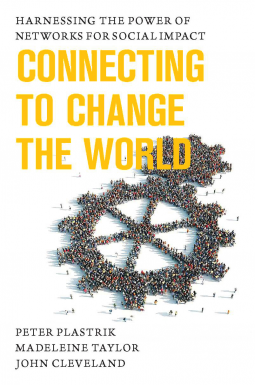
This 2014 book delves into what makes networks tick. How do networks start? How do they stay healthy? How does a network approach to work differ from an organization-based approach? Lots of real-world examples help keep this a very readable book.

The authors divide networks into three categories: connectivity, alignment, and production networks, each with its own characteristics and purposes. (They may also be phases: a single network may go through more than one of these categories over its lifetime.)

  • Connectivity networks link people for information exchange and learning.
  • Alignment networks link people to help them share ideas, goals, and strategies.
  • Production networks enable members to work together for social impact.

A strength of this book is its emphasis on network maintenance as work, and as necessary, highly skilled, challenging, time-consuming work. Often people have the impression that, once they’re established, networks steam on effortlessly towards their goals, but there’s inevitably a great deal of background effort necessary to produce that impression.

So what does the wizard behind the curtain do? This book gives a good overview. Network establishment and maintenance tasks are clearly spelled out; appendices provide useful tools, checklists and resources. There’s even a gentle list of lessons for “network engineers” — funders and others — who wish to launch networks for their own purposes, encouraging them to do so in a supportive versus a directive way.

I appreciated the emphasis on the need for adequate, appropriately-chosen IT tools for network members and on human support for their use:

“Facilitation and coordination at any of the levels we’ve described also require tools for supporting communication among members. A network’s communication infrastructure is essential to the network’s success because it will enable or impede collaboration. …

Whether it’s using e-mail, listserves [sic], or scheduling and collaboration software, there has to be a human touch to help things along. We’ve seen start-up networks in which members had access to commuications software but almost none used it. Some members didn’t want to deal with having yet another website to go to and another password to enter. Some weren’t comfortable with learning how to use the new site. Some tried the site and didn’t find anyone else there, so they dropped it. The lesson seems to be that you can’t just provide everyone with an online communications tool and expect they will start to use it. You have to encourage and support them.”

A note on language: the authors use “value proposition” in an unusual (and slightly distracting) way, to refer to both something that is offered and something that is wanted. It can take a while to parse their meaning as a result. But this is a minor quibble.

Recommended for those new to network work, but the book is also full of useful tips and resources for those already enmeshed in the network way of thinking and working.

Comments closed

Book Review – Soda Politics: Taking on Big Soda (and Winning), by Marion Nestle

Original link

An impressively exhaustive account of the soda industry, its effects on human health, and its extensive efforts to ensure profit triumphs over health concerns.

In this book Marion Nestle painstakingly disassembles, analyzes and documents every possible aspect of the enormous industry dedicated to selling drinks of sugared, flavored water to people across the planet. Beginning with the health effects, moving through marketing (to children, to minorities, to the developing world), and ending with the various flavours of political advocacy efforts, Nestle leaves the reader with a clear picture of how the industry functions. Soda Politics focuses on the USA, particularly in the sections on political efforts, but Nestle keeps the entire world well in view — as the soda companies do.

Health promoters will likely not find anything new in the health-related sections but will appreciate Nestle’s consistent acknowledgement that the health issues to which soda consumption contributes, such as obesity and diabetes, transcend individual lifestyle choices. The startling statistic that sugary drinks comprise fully half of all sugar intake (in the US) shows just how normalized it has become to drink nutritionally-empty calories.

Nestle recounts in detail how soda companies go to extensive efforts to shift attention away from calorie consumption and toward physical activity, and how they create “astroturf” groups (false “grassroots” groups that are industry-created and -funded) to fight any tax, policy, or regulation that would limit soda sales.

Health promoters familiar with tobacco control efforts will note many parallels, which Nestle notes in the text:

“To public health advocates familiar with the actions of tobacco companies, the response of soda companies to obesity seems all too familiar. Soda is not tobacco, of course, and the problems it causes depend on how much is consumed, and how often. But the soda industry’s playbook — the script it follows — is a carbon copy of the one used by cigarette companies to deflect attention from the hazards of smoking.”

Also of particular interest to health promoters will be the sections suggesting activities to use with children, including those highlighting inequality:

“Take your kids to a high-income neighborhood, low-income neighborhood, and a largely minority neighborhood and do some comparisons.

  • Which neighborhood makes sodas more readily available?
  • Which neighborhood makes fresh fruits and vegetables more readily available?
  • Why do these differences exist?”

It’s worth a read (Don’t be put off by the length: the last third is a collection of resources, references, and other supporting material.). While one is left feeling a bit squashed by the enormous industry behemoth of funding and advocacy, Nestle is careful to end on a hopeful note, describing small wins and the momentum those wins are creating. It feels much like the early days of tobacco control — and see how far that has come in the last thirty years! Perhaps thirty years from now Soda Politics will be a curious historical artefact of a strange, bygone world. We can only hope.

Coming in October 2015 from Oxford University Press.

Comments closed

Book review: Grow, by Stephen Grace

Original link

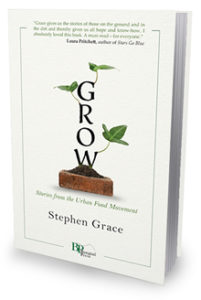
Food systems and how they affect and interact with human and ecosystem health have been a growing area of concern for health promoters in recent years. In Grow, Stephen Grace explores some community-level enterprises, experiments, and ideas in the context of urban Denver.

After the sudden death of his friend Mostafa, Stephen Grace finds himself searching for connection, happiness, and meaning. Strong associations between Mostafa and the social, comforting aspects of food lead him to Denver’s local sustainable agriculture scene.

While the theoretical notions here won’t be new to anyone already involved in or familiar with community food systems, the specifics of what’s happening in Denver are of significant interest. How can you develop a locavore food scene in a cold, dry, mostly urban environment? It’s an interesting challenge, and Grace digs deeply to find the people and stories at the root of it. Care for the earth. Care for people. Share the surplus.

While small-scale equity is dealt with sensitively, larger-scale equity issues are skimmed over:

Where will all that food come from if it isn’t transported from far-flung places by ship, train, truck and plane? John-Paul answers with one word: “Lawns”.

But what about the many people, disadvantaged and otherwise, who don’t have lawns? And what about the people living in those “far-flung” places? Perhaps that’s another book, but the emphasis on hyper-local solutions in Grow did externalize the rest of the planet. There’s also a tendency in the writing style to tell, not show, which adds a proselytizing tone in spots.

Overall: a thoughtful, hopeful primer on a complex issue, complete with an excellent (and extensive) reference list for further reading.

Comments closed

Today is Bike to Work Day!

Original link

Although many HC Link staff cycle for much or all of the year, it’s nice to take time on Bike to Work day to celebrate our favourite mode of transportation. I asked a few HC Link staff and other colleagues for a few comments.

Toronto has several group rides that head downtown from various parts of the city, ending at City Hall for a pancake breakfast. Those festivities start too early for my night-owl habits, but lots of HC Link staff will be there.

What will you be doing for Bike to Work day?

Alison says: I’ll be at CPHA in Vancouver this year and not on a bike! But if I were in Toronto, I would be riding my bike to work and all other parts.

Sam: I’m going to bike to work. Unless it’s really pouring rain.

Sara: On Bike to Work day I will be riding with the pack and loving every moment of it.

Andrea: I will be biking to work- first ride of the season as I have been quite sick over the winter. I can’t wait!

Amanda: I will be commuting into Toronto on the GO train…I would rather be biking but it`s too far!

Lisa B: I will definitely be biking to work and I am planning on attending the Bike to Work Day Group Commute & Pancake Breakfast at Nathan Phillips Square.

One of the advantages of living in Toronto is its transit system — our buses, streetcars, subways, intercity trains, and ferries. Of course we all love to complain about it, but it gives us options that just don’t exist in some other parts of Ontario. If the weather is bad or if we’re tired or ill, we don’t have to ride our bikes or resort to car travel.

How do you usually get to work?

Lisa B: I commute to work by bike in spring, summer, and fall weather permitting. If it is raining or too cold I take the TTC. I now work at PAD and bike from High Park to north of Keele and Wilson! I ride on main streets with heavy traffic but go out of my way to stay off of Keele, the ride takes me about 45 minutes each way.

Alison: To get to work I take my bike on the Toronto Island ferry and then head up Bay Street if I am in a hurry or further west to Simcoe where there’s a bike lane — a much safer way to go.

Sara: I usually walk, TTC or ride depending on the weather and my body.

Sam: Bicycle! Mostly main streets, like Bathurst and Bloor

Andrea: Usually I bike from March to December and take public transit the rest of the time. The nice things about public transit are that a) I live in a city with public transit and b) that it allows me to “bookend” transit trips with walking. The not-so-nice thing is how crowded it is. Biking is THE BEST way to get to work!

Once people start cycling, it’s hard to get them to stop. But getting people to start can be challenging: it can seem scary and intimidating to put your small, squishy, un-armored self out there in traffic with large metal boxes on wheels.

Joanne: I just got a bike — it’s my mom’s old bike. I think it has 21 gears. I just need to work up the nerve to ride it to work! I’ve never ridden in the city.

Matthuschka: I’d have to work my way up to it. We can get down to the waterfront easily but not into the core.

Remember, though, that downtown traffic moves quite slowly much of the time, so the speed differential between bikes and cars is very low. In fact, cyclists typically find they’re faster from point A to point B than a car making the same trip.

What would you say to non-cyclists on Bike to Work day?

Sara: I would tell non-riders that riding in the city is not as scary as many believe. The benefits of riding extend beyond improving your mental and physical health, it is also great for getting to know your city, for reducing emissions and saving money. As well, the more cyclists there are, the better cars will get at sharing the road. Join the fun!

Alison: Try it, you’ll like it! Cycling is fun, fast and a healthy way to get around.

Sam: since you have to go to work anyway you might as well exercise and get there for free!

Matthuschka: support the bike to work movement! even if you can’t, make it so others can. If it’s fear, then find ways to get over that fear — work on creating a safe bike network in the core of the city.

Andrea: I’d say: be brave and give it a try. Bike to Work day is a great day to try it out especially if there is a group bike happening. Also the pancakes at City Hall are delicious. But really: map out your route and try it on a weekend; pay attention and be safe and: most importantly have an awesome ride!

Amanda: Share the road! Biking is fun and great exercise.

Lisa B: I would say try cycling! Especially if you live and work in the downtown core, it is not nearly as intimidating as you might think and a great way to get some fresh air and physical activity.

Want to give it a try? Here are a few resources to help you get started:

Happy cycling!

Comments closed

Apps for Health (But are they?)

Original link

At the end of April I went to the Apps for Health conference in Hamilton.

From a health promotion perspective as well as from a technological perspective, the entire field of apps for health and wearable technology is fascinating, albeit rather larval. There is a lot going on, but not in sync — it’s a rather cacophonous space at the moment, with no standards and very little interoperability. Everyone is working alone to invent new kinds of wheels. It reminds me of the early days of personal computing. Now, we know ctrl-s (or its equivalent) will probably save your work in most computer-related things we encounter, but it wasn’t always so. I remember pointing out the “save” icon in Word to someone in the early 90s, back when the icon was meant to look like a floppy disk (remember those?), and the person said “Oh, the tv icon? I always wondered what that was for!” To be fair, it did kind of look like a TV.

That’s kind of where health apps and wearable tech are now: figuring out tiny pieces of a big field, throwing a lot of ideas at the wall (in isolation) and seeing what sticks. At the moment there are many ways to represent respiration, for example, or calories or sleep time or stress/emotion.  You could spend your whole day counting and reporting things in many single-purpose apps or devices that don’t talk to each other (or to anything else).

What does this have to do with health promotion?

Quite a bit. If we look to the Ottawa Charter’s action areas in health promotion (build healthy public policy, create supportive environments for health, strengthen community action for health, develop personal skills, and re-orient health services) and its three health promotion basic strategies (to enable, mediate, and advocate), it’s clear health promoters need to be paying attention to the possibilities and issues with technology and health.

I’ll divide my comments among the strategies.

Enable

As we move from pure data collection to apps and wearables that can help make decisions and recommendations, health promoters need to have a say in what these decisions might be. Are they healthy decisions overall, for the person and for society? Who is creating the app or wearable and what is their agenda?

There are some excellent apps and wearables being produced right now. For example, at Apps for Health I was particularly impressed with BrainFX, an app produced by several Occupational Therapists for the assessment of mild to moderate brain dysfunctions. Not only does it speed up the assessment process, it removes potential delivery bias, delivers a report immediately, and allows users to contribute their de-identified data for research. OTs benefit from spending two hours to assess someone and get a report instead of twenty hours. Patients benefit from a report that’s immediately available and so can see the specifics of their issues and begin therapy immediately instead of having to wait weeks or months for a hand-written report. Researchers benefit from a steadily increasing collection of nicely anonymous data. Win-win-win.

In the fitness realm, Zombies, Run! and The Walk, both by Six to Start (The Walk was co-produced with the UK’s NHS), are excellent examples of how to add a game layer to workouts for extra fun and reward.

On the other hand, virtually all health-related apps and wearables focus on lifestyle issues, which we know are not the major contributors to health. How can health promoters enable the kind of bigger-picture thinking that could lead to apps and wearables that consider health beyond steps and calories?

Mediate

There are many apps and wearables that aim to help develop personal skills. These are of widely varying quality, and health promoters could help guide people to more credible, reliable, practical apps and to use them in a healthy way. Is it healthy to quantify exactly how many peas your baby ate for lunch and his/her sleep to the nearest second? Or is it healthier to put down the phone and interact with the baby instead? Do we put the might of our words behind self-driving cars, which might reduce injuries, or do we help guide society away from car dependence altogether? Some apps “gamify” health by providing connections to other users based on data sharing — how can we help people disentangle their thoughts about privacy vs. the benefits of access to support? Technology needs health promoters to help mediate the larger issues.

Advocate

Privacy issues in health apps and in wearables are far, far from resolved. At Apps for Health, Ontario’s previous Information and Privacy Commissioner gave an impassioned keynote advocating Privacy By Design. That is, in her opinion (and mine), technology should by default protect the user’s privacy. If they choose to share their information, it should be clear what data is being shared, who it’s being shared with, and why. The corporatization of data and data mining are, I think we can all agree, concerning from a health promotion point of view, and advocating for transparency and Privacy By Design is something health promoters can do.

Security is also something health promoters can draw attention to. I am not at all sure I want my heart rate monitor, my baby monitor, my drug infusion pump or my house (or the power grid, for that matter) attached to the hackable Internet of Things just yet. We need to do some deeper thinking about the implications of the risks involved in connecting everything to the Internet.

Issues of equality and discrimination are key, as well, and health promoters can keep these in the public eye. Whose data is being collected from all these wearables? Well, data from people who can afford smartphones and wearables, so these people are probably from the wealthier end of society. If we’re going to be making policy choices based on collected data — for example, the City of Toronto has created a cycling app to collect information about where people ride to help future infrastructure decisions — we need to spend much more time considering who is included and who is not.

This is evident even from looking at the images that are used of wearable technology in action: wearables are almost always shown on white male bodies. When female bodies are shown at all they are shown either as billboards, wearing high heels and tight dresses displaying the technology in question on their chests or skirts, or they are wearing revealing workout gear. Women’s bodies are depicted somewhat more often in apps addressing mood or stress. In all contexts, however, the women all have long hair and (with few exceptions) are white. What does this mean about whose needs are being attended to with this technology?  What kinds of bodies are being considered “normal” and what does this mean on a societal level?


This is very early days, and health promoters have a wonderful opportunity to help guide technology in ways that will be healthy at all levels from the individual to the societal. Feel free to explore my public “wearabletech” tagged bookmarks and “apps” tagged bookmarks and, of course, any other sources that appeal to you. I encourage all health promoters to keep a weather eye on health apps and wearable technology and to speak up whenever you can.
Comments closed

5 Good Ideas – Open Data

Original link

Today I went to the Five Good Ideas (http://maytree.com/training/fivegoodideas) session* on Open Data, with speaker Harvey Low, who is Manager, Social Research & Analysis Unit, Toronto Social Development Finance & Administration with the City of Toronto. I have capital-O Opinions about data, transparency, and the differences between data, information, and knowledge (or wisdom), so I was particularly interested to hear Mr Low’s ideas.

His five good ideas:

1. Data is not just for geeks.
Everyone in the nonprofit sector needs to think about how they’re using data to make decisions.

2. You don’t realize what you have.
Turning data into information (and then into knowledge) is a different issue, but think about what you might have that could help. Can you demonstrate the extent of a problem? Do you have any data that others might not? How could you share it? How can we make sure data is captured and released consistently so it can be compared over time?

3. Bridge the data-policy divide.
“We’re not good at linking data to social issues,” says Low. Do you have anything that could link Problem A with Potential Policy B? Does anyone? Data is key to evidence-based planning (which Toronto has, he says, embraced). But not just any data — it’s about releasing RELEVANT data that can be used to help solve problems.

4. Technology can be a friend.
Sometimes we need to think out of the box — for example, how can we apply AODA accessibility principles to spatial interpretation of information (maps) — but technology lets us share, combine and recombine information in new ways.

5. Walk the talk (make open data real).
You get more leverage and value if you share what you have (minding privacy and legal issues appropriately). Data goes out; hopefully wisdom circles back.

He shared a number of excellent resources which are now posted on Maytree’s website (http://maytree.com/fgi/five-good-ideas-use-share-contribute-open-data.html). Several others arose during the discussion:

1. The Mowat Centre’s  An Open Future: Data priorities for the not-for-profit sector http://mowatcentre.ca/an-open-future/
2. Datalibre.ca: urging governments to make data about Canada and Canadians free and accessible to citizens http://datalibre.ca/

There was mention of the Toronto Cycling app, which several of us in the Health Nexus office use to give the city our data about where we cycle. That data will be used to help create cycling infrastructure, but people may find other interesting uses for it as well.

Coincidentally, an article on open data examples from cities in the USA was waiting for me back at the office (http://www.citylab.com/cityfixer/2015/04/3-cities-using-open-data-in-cre…).

The group discussion raised a few sticky issues.

1. Lack of a good venue for nonprofits to share data.
More and more it is clear that this is a niche that’s nearly empty at the moment. Where would YOU share your data? The Toronto Foundation (https://torontofoundation.ca/), which works with the City of Toronto to release data relevant to the social determinants of health, kindly offered its services and encouraged anyone who would like to share their data with the city to give them a call. Outside Toronto, however, and at regional/provincial/federal levels, it’s a difficult question.

2. The potential privatisation of personal information.
As we’ve seen, large companies are inclined to take liberties with people’s information. Releasing open data could add to this trend if it isn’t considered carefully.

3. Conflicts between data and ideology
You can pick and choose data to support a predefined conclusion to support your policy, but if it’s open data someone else can show what you have done. Some governments aren’t fond of this idea.

The discussion concluded with Low’s firm belief that data is a human right, and that we need to advocate for the return of the long-form census. I have to agree: to make Canada as good a place to live as we can, people must be able to draw their own conclusions about the evidence for policies and about the effects policies might have — and for that we need open data.

* If you’re not familiar with Maytree’s Five Good Ideas series, I encourage you to check it out. You can attend sessions in person in downtown Toronto or via livestream. Recordings are posted quickly after the session. Sessions are typically a half-hour presentation (with lunch, for onsite attendees), half an hour of discussion with others at your table (there is a facilitated discussion for online attendees as well), then half an hour of discussion with the whole group.

Comments closed

How can you tell if your referrals are working? Map them!

Original link

ou’re part of a network of services that relies on referrals for efficient client service—employment supports, perhaps, or health services, or community services for youth or for homeless people or people with mental illness. It’s your job as a group of services or agencies to make sure people access the services they need efficiently and appropriately.

Perhaps it’s working well. Perhaps it’s not.  How can you tell? How can you improve?

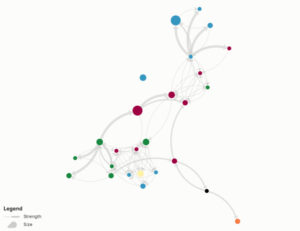
Network mapping helps you to visualize referral patterns
Network mapping creates pictures of referral patterns so you can explore what’s happening, show off your successes, and pinpoint any opportunities to improve.

We begin by asking you about your network goals:
•    Are you worried that certain services are abundant while others are missed?
•    Are some population groups falling through the cracks?
•    Are there regions which are generously served or underserved?

Answers to questions in this section help give meaning to the referral data we collect later in the survey.

It starts with a survey

Network maps are most useful when a high proportion of a network’s members participate, so we try to get as high a response rate to the survey as possible.
We begin with a survey of network members themselves, and might ask questions about:
•    services that each organization provides.
•    population groups that are served or targeted.
•    geographic areas covered—parts of a city, municipalities in a region, etc.
•    size of the organization. Is it one person? A large institution?
•    age of the organization. Is it new? Has it been around for 20 years?

Do you already know this information?  Great! We can put it straight into the dataset instead of asking questions.

We then ask questions about the referrals in your network:
•    We find it is most accurate to ask this question backwards, “How often does <organization> refer clients TO YOU?”
This prevents respondents from over-answering, “Hmm, I sent someone there once, so I’ll say yes!” and thus gives a clearer picture.

Maps show patterns

Once we’ve collected all the survey responses we can possibly collect, we’re at the fun part: creating network maps and helping tease out the information that the network will find useful.

Using the referral data and the survey information about network members, we look for referral patterns that make sense, some that are surprising and some that could be improved.

We try to learn about the stories behind the maps, such as:

  • Why do certain members on the map have no connections?
    • Is it true, or did they simply fail to answer the survey?
  • Do current referral patterns make sense, for example:
    • Member A refers only annually to Member B?
    • Member C receives frequent referrals from many other members although they have only 2 staff members?

By mapping your referral patterns, you can demonstrate the great work you’re already doing, and plan for more effective referrals in the future.

Comments closed

March 2 Health in All Policies Forum

Original link

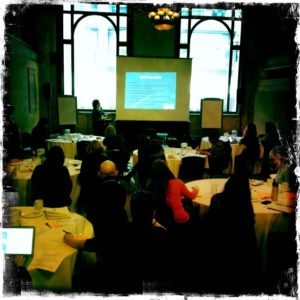
On March 2, over 30 people from around Ontario met at the lovely Ontario Heritage Trust building in downtown Toronto to talk about Health in All Policies.

Karen Loney from Chatham-Kent Public Health Unit was our MC for the day, moving the group through introductory presentations by Andrea Bodkin (HC Link Coordinator), who talked about the HC Link Policy Learning Community, and Kim Bergeron (Public Health Ontario), who gave an introduction to the Health in all Policies concept.

March 2 Policy Forum (Photo: Robyn Kalda)Presentations on specific Health in All Policies work followed. Tanya Hill from Hastings & Prince Edward Counties Health Unit, Karen Loney, Andrea Bodkin gave examples of work from different areas and discussed the challenges inherent in developing policies that affect health but that are outside the traditional bounds of what people think of as “health” — urban planning, for example.
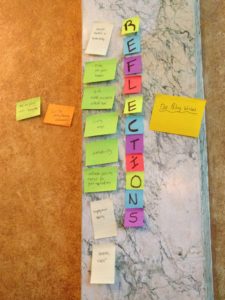
Small-group and then large-group discussions gave participants a chance to discuss how they are using, or could use, Health in All Policies in their work.

As always, there were discussions about language. Are there better words to use than “health”? Does “wellness” perhaps make it clearer that we’re talking beyond the health-care system? Is using “citizen” exclusionary in policy development work? While it can be a strong reminder to politicians about where their support is found, the group suggested “residents” or just plain “people” as more inclusive options.

In the afternoon Kim Bergeron, Lorna McCue (Ontario Healthy Communities Coalition/HC Link), and michael kerr (Colour of Poverty – Colour of Change) presented tools and resources they found helpful.

The last session was a short focus group session on the HC Link Policy Learning Community now and in future.

To end the day, attendees each offered a one-word summary of their thoughts. A few of these reflective words:

  • engagement
  • collaboration
  • rural
  • complexity
  • language
  • multi-sectoral collaboration
  • reframing
  • opportunities
  • challenges

The slides and other resources have now been posted on the HC Link Policy Learning Community discussion group – see here Additional resources are posted as replies to the initial “Health in All Policies Forum Resources” discussion forum, so keep scrolling down to see everything.

Thanks to all attendees for their insight and enthusiasm!

You will need to be a member of the HC Link Policy Learning Community to add comments or contribute your own links and resources.

Join the HC Link Policy Learning Community

March 2 Policy Forum (Photo: Robyn Kalda)


Comments closed

Questions people are asking about social media

Original link

Social media has been a popular topic for HC Link webinars, consultations and workshops this year in both English and French and we’re seeing some interesting trends.

There are starting to be three levels of questions about social media, now that it’s been around for some years.

First, there are the how-to and what-is-it questions. How do I set up a Facebook or Twitter account? How do I post? What’s Instagram/Pinterest/Vine? What is an app and how do I get one? What new things are out there?

Second, there are questions about how to use social media tools effectively. Which tool is best for my purposes? How often should I tweet? What does the research say: is social media a good tool for making a difference? Who should run our Facebook page? Should I use my real name for my work posts?

Finally, there are some more overarching questions. What’s the best way to realize the advantages of technology without being constantly attached to it? What are the best times to use social media with parents so that you’ll reach them but won’t distract them from their children at times they are likely to be parenting? Given the 24/7 nature of social media, how can we be effective online without worsening people’s work/life balance? How much sense does it make to redeploy staff time into social media at, perhaps, some cost to face-to-face services?

As health promoters, it’s important to pay attention to all three kinds of questions. It’s no use to know about all the technologies that are out there but remain oblivious to the larger questions around their healthy use. It’s also no help to ignore technology on the pretext of concerns about its use. There are no clear answers to the big-picture questions yet, but health promoters need to be part of the discussion.

For social media resources, you can check out:

Comments closed