Press "Enter" to skip to content

Tag: BookReview

Book Review – A Survival Guide to the Misinformation Age: Scientific Habits of Mind, by David J. Helfand

Original link

“This world faces daunting challenges–from energy supplies to food supplies, from biodiversity collapse to the freshwater crisis, and, at the root of many of these issues, global climate change. Yet we shrink from confronting these challenges because we don’t like numbers and are more comfortable with beliefs than with rational thought” (loc 46)

Evidence, and being evidence-based, is a major theme in health promotion work right now. Of course evidence is a good thing, but what counts as evidence from a scientific perspective, and what skills do we need in order to evaluate whether it’s good evidence or not?
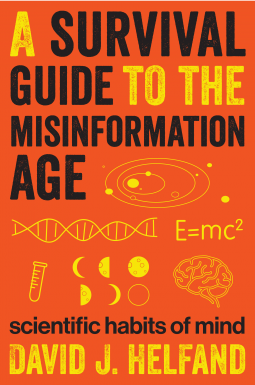
David J. Helfand’s book (published February 2016) is a good overview of the basics of scientific thinking. Helfand clearly loves science and his writing conveys the wonder and excitement of a scientific perspective.

“Adopting these habits of mind opens up worlds both unseen and unseeable to understanding. It allows us to read the history of the deep past and to predict the future. It provides us with context: our “pale blue dot is but one of eight planets and a few dozen moons orbiting one of a hundred billion stars (many of which, we now know, also have planets) that make up the Milky Way, one of a hundred billion galaxies in our visible corner of the universe. That, far more than a “rainbow in heaven,” is awe-full — it inspires awe.”(loc 232)

Helfand uses relatable examples to illustrate the habits of mind he describes: how much does a rainstorm slow down a baseball? If the US national debt is $1.7 trillion, how much is that per person? Based on a coin-toss rule, who should pay for lunch? The last chapter neatly pulls all the ideas and habits together, working through the example of climate change.

His tone tends toward the curmudgeonly, which I enjoyed tremendously:

“US consumers spent over $3 billion on homeopathic medicine in 2007, obtaining distilled water from which the last trace of such invaluable ingredients as crushed whole bees, red onions, and white arsenic were originally dissolved (a terrible waste of bees in my view).” (loc 3068)

I do worry that he may have pitched the book slightly higher than its ideal audience — those who, as per my first quote, don’t like numbers — might require. But if you made it through high school algebra (whether you remember any of it or not) and understand the basics of how graphs work, the math here shouldn’t be too frightening. There are formulas, but if you’re comfortable enough with the concepts Helfand is discussing, parsing the exact details of each calculation isn’t necessary to follow his argument. It’s the habits of mind and general approaches he discusses that are important, not the calculations in his examples. I’m sure he’d agree, given that one of those habits is “back of the envelope” estimation.

It is, of course, fully referenced and includes appendices with tips and practice questions for each chapter.

Recommended for anyone who’d like to stretch their science muscles or who frowns when someone mistakes “less” for “fewer”.

Comments closed
Book Review – The Idealist: Aaron Swartz and the Rise of Free Culture on the Internet, by Justin Peters

Original link

Aaron Swartz died three years ago today, but the issue — and yes, ownership of information is a health promotion issue — of who controls what you can post and see on the Internet is most definitely still with us.

For those unfamiliar with Swartz, copyright issues, the open-source movement, and the technical details of his actions, never fear. This book gives not only a thorough accounting of his case but also a history of how copyright came to be as it is and why one might wish it to be otherwise, without being dry or plodding:

“Like a truffle dipped in ipecac, a gift wrapped with poison ivy, Webster’s good ideas were often ruined by their repellent packaging.”

It’s also a tale of complexity and of unintended consequence, of the sort that health promoters will find familiar:

“It is important to remember, however, that the availability and affordability of these pirate editions engendered a book-reading public in nineteenth-century America, which would eventually engender a more mature publishing industry. In this context, what better served America and Americans? To give authors tight control over their works, so that they could profit from their good ideas? Or to build a nation of readers by relaxing restrictions on the flow and dissemination of content? Was copyright a set of social relationships, or was it an inalienable property right? Even after passage of the Copyright Act of 1831, American lawmakers weren’t sure.”

With the rise of the Internet, it’s clear we’re still not sure about how the balance should fall, as Swartz’ case demonstrates.

Swartz himself seemed to me a difficult person, driven and well-intentioned but immature and with a tendency to choose the quick, decisive route over the slow-but-sure.  His is a cautionary tale about what can happen when you do too much, too fast, which may provide solace for health promoters and policy advocates frustrated with the slow pace of change.

“I felt like he certainly had sort of the conviction of youth, in the sense that he was convinced that whatever he was doing at any one time — or at least he sort of projected this — he was absolutely convinced that that was the way to go,” his friend Wes Felter said. “And the thing is that most people sort of outgrow that, and I don’t know if he ever did.”

Brewster Kahle, mentioned in the book, gives his gentler view here (video and transcript).

As the free availability of accurate, complete information is of critical importance for people’s ability to make decisions in all areas of life I’d encourage health promoters to read up on information-control issues, and this book is an excellent place to start.

A well-researched, insightful, and human view into copyright law and its various abuses (on multiple sides!) through history, and a fair requiem for Swartz.

Comments closed

Book review – Connecting to Change the World: Harnessing the Power of Networks for Social Impact, by Peter Plastrik, Madeleine Taylor, & John Cleveland

Original link

This 2014 book delves into what makes networks tick. How do networks start? How do they stay healthy? How does a network approach to work differ from an organization-based approach? Lots of real-world examples help keep this a very readable book.
The authors divide networks into three categories: connectivity, alignment, and production networks, each with its own characteristics and purposes. (They may also be phases: a single network may go through more than one of these categories over its lifetime.)

  • Connectivity networks link people for information exchange and learning.
  • Alignment networks link people to help them share ideas, goals, and strategies.
  • Production networks enable members to work together for social impact.

A strength of this book is its emphasis on network maintenance as work, and as necessary, highly skilled, challenging, time-consuming work. Often people have the impression that, once they’re established, networks steam on effortlessly towards their goals, but there’s inevitably a great deal of background effort necessary to produce that impression.

So what does the wizard behind the curtain do? This book gives a good overview. Network establishment and maintenance tasks are clearly spelled out; appendices provide useful tools, checklists and resources. There’s even a gentle list of lessons for “network engineers” — funders and others — who wish to launch networks for their own purposes, encouraging them to do so in a supportive versus a directive way.

I appreciated the emphasis on the need for adequate, appropriately-chosen IT tools for network members and on human support for their use:

“Facilitation and coordination at any of the levels we’ve described also require tools for supporting communication among members. A network’s communication infrastructure is essential to the network’s success because it will enable or impede collaboration. …

Whether it’s using e-mail, listserves [sic], or scheduling and collaboration software, there has to be a human touch to help things along. We’ve seen start-up networks in which members had access to commuications software but almost none used it. Some members didn’t want to deal with having yet another website to go to and another password to enter. Some weren’t comfortable with learning how to use the new site. Some tried the site and didn’t find anyone else there, so they dropped it. The lesson seems to be that you can’t just provide everyone with an online communications tool and expect they will start to use it. You have to encourage and support them.”

A note on language: the authors use “value proposition” in an unusual (and slightly distracting) way, to refer to both something that is offered and something that is wanted. It can take a while to parse their meaning as a result. But this is a minor quibble.

Recommended for those new to network work, but the book is also full of useful tips and resources for those already enmeshed in the network way of thinking and working.

Comments closed

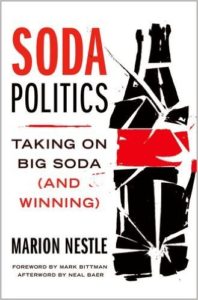
Book Review – Soda Politics: Taking on Big Soda (and Winning), by Marion Nestle

Original link

An impressively exhaustive account of the soda industry, its effects on human health, and its extensive efforts to ensure profit triumphs over health concerns.
In this book Marion Nestle painstakingly disassembles, analyzes and documents every possible aspect of the enormous industry dedicated to selling drinks of sugared, flavored water to people across the planet. Beginning with the health effects, moving through marketing (to children, to minorities, to the developing world), and ending with the various flavours of political advocacy efforts, Nestle leaves the reader with a clear picture of how the industry functions. Soda Politics focuses on the USA, particularly in the sections on political efforts, but Nestle keeps the entire world well in view — as the soda companies do.

Health promoters will likely not find anything new in the health-related sections but will appreciate Nestle’s consistent acknowledgement that the health issues to which soda consumption contributes, such as obesity and diabetes, transcend individual lifestyle choices. The startling statistic that sugary drinks comprise fully half of all sugar intake (in the US) shows just how normalized it has become to drink nutritionally-empty calories.

Nestle recounts in detail how soda companies go to extensive efforts to shift attention away from calorie consumption and toward physical activity, and how they create “astroturf” groups (false “grassroots” groups that are industry-created and -funded) to fight any tax, policy, or regulation that would limit soda sales.

Health promoters familiar with tobacco control efforts will note many parallels, which Nestle notes in the text:

“To public health advocates familiar with the actions of tobacco companies, the response of soda companies to obesity seems all too familiar. Soda is not tobacco, of course, and the problems it causes depend on how much is consumed, and how often. But the soda industry’s playbook — the script it follows — is a carbon copy of the one used by cigarette companies to deflect attention from the hazards of smoking.”

Also of particular interest to health promoters will be the sections suggesting activities to use with children, including those highlighting inequality:

“Take your kids to a high-income neighborhood, low-income neighborhood, and a largely minority neighborhood and do some comparisons.

  • Which neighborhood makes sodas more readily available?
  • Which neighborhood makes fresh fruits and vegetables more readily available?
  • Why do these differences exist?”

It’s worth a read (Don’t be put off by the length: the last third is a collection of resources, references, and other supporting material.). While one is left feeling a bit squashed by the enormous industry behemoth of funding and advocacy, Nestle is careful to end on a hopeful note, describing small wins and the momentum those wins are creating. It feels much like the early days of tobacco control — and see how far that has come in the last thirty years! Perhaps thirty years from now Soda Politics will be a curious historical artefact of a strange, bygone world. We can only hope.

Coming in October 2015 from Oxford University Press.

Comments closed

Book review: Grow, by Stephen Grace

Original link

Food systems and how they affect and interact with human and ecosystem health have been a growing area of concern for health promoters in recent years. In Grow, Stephen Grace explores some community-level enterprises, experiments, and ideas in the context of urban Denver.

After the sudden death of his friend Mostafa, Stephen Grace finds himself searching for connection, happiness, and meaning. Strong associations between Mostafa and the social, comforting aspects of food lead him to Denver’s local sustainable agriculture scene.

While the theoretical notions here won’t be new to anyone already involved in or familiar with community food systems, the specifics of what’s happening in Denver are of significant interest. How can you develop a locavore food scene in a cold, dry, mostly urban environment? It’s an interesting challenge, and Grace digs deeply to find the people and stories at the root of it. Care for the earth. Care for people. Share the surplus.

While small-scale equity is dealt with sensitively, larger-scale equity issues are skimmed over:

Where will all that food come from if it isn’t transported from far-flung places by ship, train, truck and plane? John-Paul answers with one word: “Lawns”.

But what about the many people, disadvantaged and otherwise, who don’t have lawns? And what about the people living in those “far-flung” places? Perhaps that’s another book, but the emphasis on hyper-local solutions in Grow did externalize the rest of the planet. There’s also a tendency in the writing style to tell, not show, which adds a proselytizing tone in spots.

Overall: a thoughtful, hopeful primer on a complex issue, complete with an excellent (and extensive) reference list for further reading.

Comments closed